Options Portfolio Collects $102 as NVDA Remains the Main Risk
As of July 31, 2026, the stock portfolio closed at $12,840, down a modest 0.44% week over week. Not every week can be a victory lap, and this one was more about defending positions than celebrating gains.
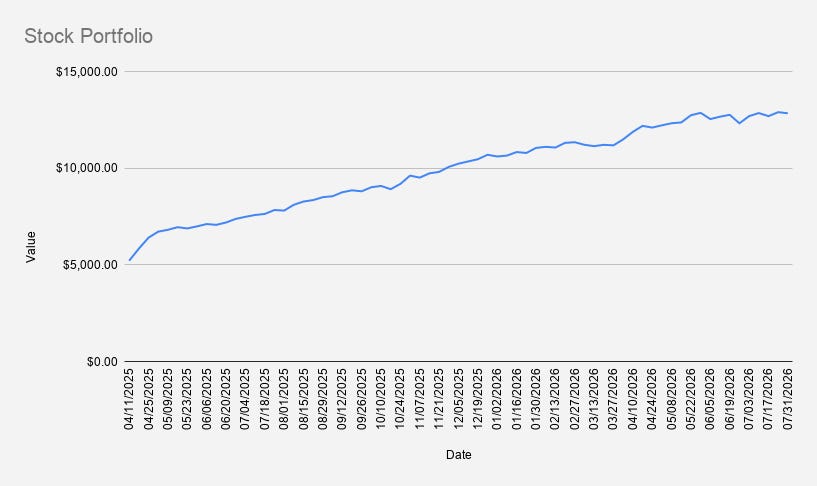
Despite the slight weekly decline, the longer-term picture remains encouraging. The portfolio is now up 24.46% year to date, comfortably ahead of both the S&P 500 (+8.89%) and NVDA (+4.72%).
The main source of excitement—and stress—was once again NVDA. The stock quickly fell below $200, putting pressure on our credit spread and forcing me to act. Rather than waiting and hoping for the best, I rolled the position forward and down to lower strikes.
At one point, it looked increasingly possible that I might need to prepare for assignment and eventually switch to covered-call writing on NVDA. That would not necessarily be a disaster, but it would certainly change the structure and risk profile of the portfolio.
NVDA recovered slightly by the end of the week, but I do not think the danger has passed. In the longer term, I would not rule out a decline toward $170 or even $160. Since the portfolio uses leverage, a move of that size would increase tail risk and give me something more substantial to worry about than deciding which stock to buy with the next $10 of premium.
From a technical perspective, I would not rule out NVDA testing the $165 level at some point. The risk would become more serious if the 50-day moving average crosses below the 200-day moving average. Such a bearish crossover currently appears plausible, particularly as NVDA approaches its earnings report at the end of August.
NVDA remains the portfolio’s most important position to watch. It has been one of the strongest companies in the market, but even strong companies can experience painful corrections—especially when expectations are high enough to require perfection.
Away from NVDA, I made a small purchase of McDonald’s shares at the beginning of the week. Following its earnings report, I also opened a new credit spread on Bristol Myers Squibb. In addition, I purchased fractional shares of NFLX and NVDA.
I also enabled automatic dividend reinvestment for the dividend portion of the portfolio. From now on, dividend income will automatically be used to purchase additional shares.
Since I already manage the portfolio actively, this is not a dramatic strategic change. Still, it introduces another quiet compounding mechanism. Dividends from BMY, NVDA, and the other holdings can now gradually accumulate more shares without requiring any manual action. It is not exciting, but neither is brushing your teeth—and both tend to work better when done consistently.
Current Options Positions
NVDA AUG 7, 2026 190/170 Bull Put Credit Spread
LHA FRA Sep 18, 2026 7.6 Cash-Secured Put (EUR)
ARCC Sep 18, 2026 16 Cash-Secured Put
HEL STERV SEP 18, 2026 8.5 Cash-Secured Put (EUR)
NFLX Sep 18, 2026 80/85 Bear Call Spread
BMY OCT 16, 2026 57.5/52.5 Bull Put Credit Spread
NVDA Jun 17, 2027 $125 Covered Call
NFLX Dec 17, 2027 64 Cash-Secured Put
The new BMY position deserves some additional explanation. At the beginning of the week, I had no intention of opening another trade while the NVDA spreads were still demanding attention. Adding risk while another position is under pressure is rarely ideal.
In the end, however, I decided that the BMY trade represented a calculated and manageable risk. BMY is a strong dividend-paying company and acts as one of the anchor holdings in the dividend section of the portfolio.
I also try to reinvest options premium into BMY shares, especially when opening trades linked to the company. This creates a simple cycle: collect premium, build the underlying position, and allow dividends to purchase even more shares over time.
I would normally open two credit spreads, but this week I limited the BMY position to just one. With NVDA already creating enough entertainment, there was no need to invite a second circus into the portfolio.
For now, I do not expect to open any additional August positions. I would prefer to wait for most of the September trades to expire before adding more long-dated exposure. During August, NVDA will likely remain the only position requiring active management.
Total options premium collected this week reached $102.62. Considering the current size of the portfolio and the level of risk being taken, this was a respectable result.
Part of that premium income was reinvested directly into the portfolio through the purchase of 0.1 share of NVDA, 0.1 share of NFLX, 0.25 shares of BMY, and 0.1 share of MCD.
These are small purchases, but the objective is not to impress anyone with a single transaction. The goal is to build positions steadily through a combination of options income, dividends, and disciplined accumulation.
The current margin balance has decreased to −$2,574. At the present repayment pace, it would theoretically take around 25 weeks to eliminate the debt completely.
That estimate is probably optimistic. Over the next few weeks, I doubt weekly options premium will even reach $40, so the actual repayment period is likely to be longer. Still, the direction is more important than the exact timeline: the margin balance is gradually moving lower.
Looking ahead to next week, the main focus will remain the NVDA $190/$170 bull put spread.
Should the position come under renewed pressure, the plan is to roll it forward—ideally for a net credit—while keeping the risk controlled. Assignment remains a possible outcome, and if it happens, the next chapter of the strategy may involve covered-call writing on NVDA.
That is the nature of this portfolio journey. Some weeks are about collecting premium, some are about buying shares, and others are simply about surviving long enough to trade another week.

