Greetings from Shekvetili and Georgia’s famous Paragraph Hotel!
After quite an adventurous day, including a cancelled local flight, we finally made it here by car. We’re spending the next few days enjoying one of the wedding gifts we received back in the summer of 2026.

The weather is lovely, the outdoor swimming pool is even better, and meanwhile, the stock market is taking a beating.
As of November 20, our dividend stock portfolio stood at $11,311. That’s $1,465 lower, or 11.47% down, from the $12,776 I reported in Week 84. It’s the biggest one-week drop in account value since I started this journal. At this point, it’s starting to feel more like the crypto market than a dividend stock portfolio!
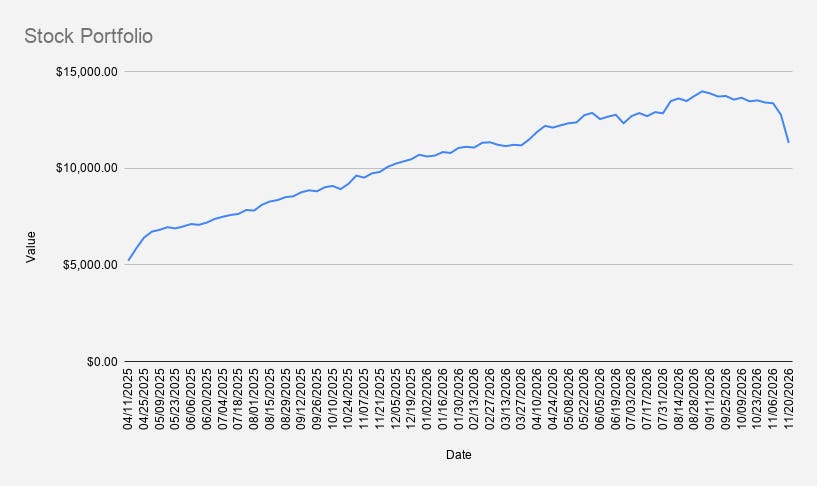
The highest weekly value in this journal was $13,973 on September 4, in Week 74. We’re now $2,662 below that high, a drawdown of 19.05%. Getting back to that mark from $11,311 would take a 23.53% gain. The $15,000 year-end target would take 32.61%. That suddenly feels a long way off.
Today’s figure puts us back at roughly the same account value as February 20, when we were at $11,312. Months of steady progress have gone in a few rough weeks. It’s a painful reminder of how quickly the account can move when one stock makes up a large part of it and we’re also trading options on margin.
Tracking snapshot still showed the portfolio up 14.53% year to date, versus 2.57% for the S&P 500 and a 27.98% decline for NVIDIA.
What happened in the stock market this week?
Friday was still trading when I took the portfolio snapshot. NVIDIA was around $136 in my snapshot, down more than 40% from its October intraday high.
NVIDIA’s earnings were strong. On Tuesday, the company reported $115.8 billion in quarterly revenue, up 103% year over year, and gave a $130 billion revenue outlook for the next quarter, plus or minus 3%. The part I’m watching is gross margin. It was 74.8% on a GAAP basis this quarter, and management guided to 71%–72% for the next one. Data-center demand is still strong, but investors also have to decide what they’re willing to pay for that growth while margins ease and the company goes through a leadership transition.
The Fed minutes added another reason for caution. Almost all participants thought further rate increases would likely be appropriate under their baseline outlook. Higher rates make it harder to justify paying up for profits that are years away. My read is that a sharp bounce after this much selling is possible. I’d take it more seriously if chip stocks joined in and NVIDIA could reclaim and hold $150. For our account, the more immediate question is how much further we can afford to let NVDA fall.
Current open options positions
NVDA, November 27, 2026 · $120/$115 put credit spread
BAC, December 18, 2026 · $57.50/$60 bear call spread
LHA (Frankfurt), December 18, 2026 · €7 cash-secured put
NFLX, February 19, 2027 · $75/$85 bear call spread
BAC, March 19, 2027 · $55 short put
BMY, March 19, 2027 · $55 cash-secured put
NFLX, December 17, 2027 · $64 short put
NVDA, January 21, 2028 · $130 covered call
We opened an additional bear call spread on Netflix, expiring in February 2027. I occasionally sell these against a struggling position to collect some premium. It’s a separate trade from the short put, with its own risk if Netflix rallies.
We also rolled our weekly Bristol Myers Squibb put down and out to March 2027, lowering the strike from $60 to $55. That cuts the purchase obligation by $500 per standard contract if we’re assigned, and it gives the position more time. We still have three underwater puts in BMY, NFLX and BAC. I’d like to see BAC and BMY find some breathing room by March.
I made a few technical mistakes managing the weekly NVDA credit spread. I booked a small loss while rolling this week’s $130/$125 spread into next week’s $120/$115. With the market getting spooked, I apparently got spooked myself. I opened too early, closed too early, and made more adjustments than I needed to. A bit of a mess, frankly. We’re still running the weekly strategy, and this week was a good reminder to price a roll before deciding whether it’s worth doing.
Options premiums and margin debt
We reported $142 in options premium this week. Some of that cash came from the BMY roll to March and the new NFLX spread out to February. The positions are still open, and the eventual profit or loss depends on how they’re closed or settled. I used part of the premium to buy 0.1 BMY, 0.2 NVDA, 0.1 NFLX and 2 NIO shares.
Margin debt is down to about $2,209, an improvement of $112 from last week’s $2,321. At $140 a week applied entirely to repayment, it would take about 16 weeks before interest. With several positions underwater and capital tied up, I think $30–$40 a week is a more realistic premium expectation for now. If I could put all of that toward the debt, the same arithmetic comes to roughly 55–74 weeks, before interest and assuming no new borrowing. That gives me a better sense of the trade-off when I use some of the premium to buy shares.
What I’m watching next week
Wednesday, November 25 is the big day. We’ll get October’s PCE inflation report and the second estimate of third-quarter U.S. GDP in the morning, followed by the Fed’s Beige Book in the afternoon. If inflation runs hot and yields climb, I’d expect the higher-priced growth stocks to stay under pressure. Cooler inflation and a broader rebound across chips would give me more reason to believe a bounce can hold. U.S. equity markets close for Thanksgiving on Thursday and shut early at 1:00 p.m. Eastern on Friday.
In the portfolio, Friday’s NVDA $120/$115 put spread is the next expiry. At my $136 snapshot, the stock was only $6 above the $130 covered-call strike and $16 above the spread’s $120 short strike. The covered call leaves us exposed to further losses on the shares. The $5-wide put spread has up to $500 of gross strike exposure per standard contract, less the credit received. I’ll check the broker’s holiday cutoff and decide by Wednesday what I’m willing to pay to close it if NVIDIA keeps sliding. I’ll also watch the combined assignment exposure on BAC, BMY and NFLX, especially if they weaken together.
I’m still hoping for a little relief from a Santa Claus rally. I’d happily take a bounce, but we’re asking a lot of the portfolio if we need it to get back to $15,000 by year-end. For next week, I’d call it progress if we can reduce margin a little more and get through Friday without making another rushed roll. Markets have a habit of surprising us. Let’s hope the next surprise is a pleasant one.
Originally published on ReinisFischer.com.