NVDA Surge, NFLX Credit Spreads and a Record $245 Options Income Week
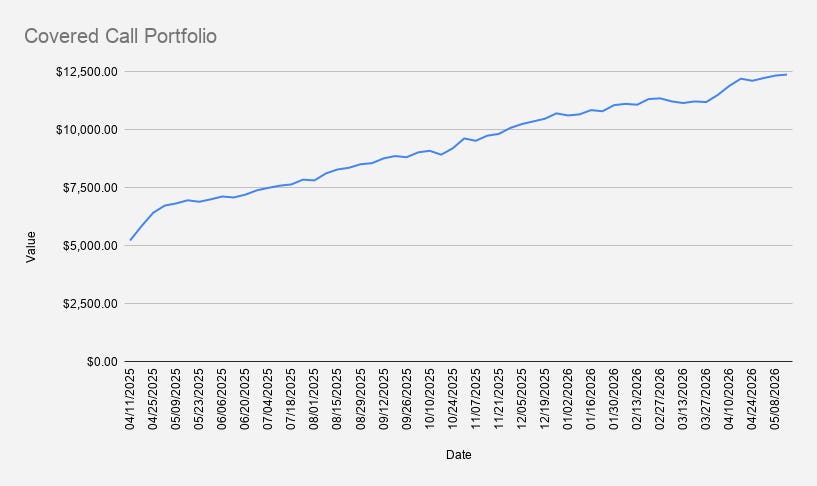
As of May 15th, 2026, our stock portfolio powered by options trading increased by another +0.36%, reaching $12,367.
On a year-to-date basis, the portfolio is now up 18.95%, outperforming the S&P 500 (+8.18%), though still slightly trailing NVDA itself, which gained +20.38% over the same period.
This week was largely driven by a massive rally in NVDA stock, which at one point surged above $230 per share. Because of that move, I decided to proactively roll our covered call position from November to the June 27, 2027 expiry. The original covered call, struck at $120, had become extremely deep in the money.
One lesson I keep relearning with covered calls is that while they generate steady income, they can also cap upside very aggressively during strong bull runs. In our case, even though the position remains highly profitable with the stock effectively capped around $125, it’s psychologically difficult watching a stock continue to run far beyond the strike price. Rolling the call forward gives more room, more time, and hopefully a chance to recover some of the unrealized upside over the long term.
At this stage, I continue treating NVDA as the anchor position in the portfolio rather than trying to maximize short-term gains from it.
Another factor influencing the portfolio this week was currency fluctuation. The U.S. dollar strengthened against the euro again, trading around 1.16 EUR/USD. Since part of our reporting is euro-sensitive, the stronger dollar slightly reduced the portfolio’s USD-equivalent value. At one point during the week, the portfolio briefly moved above $12,500 before pulling back. It’s a useful reminder that for international investors, exchange rates can materially impact portfolio performance even when the underlying assets are rising.
One strategic adjustment I’m making now is reducing dependence on NVDA for weekly premium generation. After such a strong rally, selling weekly credit spreads on NVDA feels increasingly uncomfortable due to the risk of a sharp downside reversal. Momentum works both ways, and highly extended moves can punish option sellers quickly.
Because of that, this week I introduced NFLX into the portfolio. My plan is to test Netflix credit spreads over the next 10 weeks to evaluate whether it deserves a permanent role in the strategy or whether I should continue searching for another candidate with better risk/reward characteristics.
I also made a small adjustment to our PFE strategy. Today, our PFE puts expired worthless, and instead of continuing to sell puts on the stock, I decided to stop the wheel strategy there entirely. Going forward, the plan is to gradually accumulate 0.5 shares of PFE weekly as a long-term dividend position.
Current options positions:
NVDA May 22, 2026 197.5/185 Bull Put Credit Spread
NFLX May 22, 2026 84/79 Bull Put Credit Spread
2x BMY Jun 18, 2026 50/46 Bull Put Credit Spread
DBK FRA Jun 19, 2026 24/20 Bull Put Credit Spread
ARCC Sep 18, 2026 16 Cash-Secured Put
NVDA Jun 17, 2027 $125 Covered Call
Using premium collected from the NVDA and NFLX credit spreads, I added another 0.1 shares of NVDA, 0.2 shares of NFLX, and 0.5 shares of PFE.
This remains one of the core ideas behind the portfolio: using options premium not only for short-term cash flow, but as a mechanism to continuously accumulate productive assets over time. Even small weekly additions can compound meaningfully when repeated consistently.
As a result of these additions, our projected yearly dividend income increased to $64.17. Obviously, this is still a very small dividend stream, but the focus here is not maximizing immediate yield. The focus is building a self-reinforcing system where options premium finances gradual portfolio expansion without requiring constant new capital injections.
Another major objective remains reducing margin debt while preserving the core holding of 100 NVDA shares.
This week produced a record-high $245 in options premium income. However, I don’t expect this pace to continue consistently. Realistically, future weeks will probably generate closer to $100 in weekly premium on average.
At the current margin balance of approximately -$3,130, maintaining a sustained $245 weekly pace would theoretically eliminate the debt within roughly 13 weeks. But markets rarely stay that favorable for long. Based on more realistic expectations, it’s becoming increasingly unlikely that the margin balance will reach zero during 2026.
And honestly, that’s acceptable to me.
One thing options trading teaches over time is that survival and consistency matter far more than forcing unrealistic timelines. Given the current portfolio structure and risk exposure, I’m comfortable extending the debt-reduction timeline into 2027 if necessary.
Looking ahead, next week’s key event will be the NVDA earnings report. After the extremely aggressive rally over the past weeks, my expectation is that price action could finally begin to calm down somewhat after earnings are released. Whether that happens through consolidation, sideways movement, or volatility compression remains to be seen, but I would welcome a more stable environment for options selling.
The key positions to monitor next week will be:
NVDA 197.5/185 Bull Put Spread
NFLX 84/79 Bull Put Spread
If either position comes under pressure, the plan remains unchanged: roll forward whenever possible, ideally for a net credit, while continuing to prioritize long-term portfolio stability over short-term perfection.
