Credit Spread Trade Management: Rolling an NFLX Position Into a Cash-Secured Put
Portfolio Value: $12,540
Weekly Change: -2.5%
YTD Return: +21.07%
Options Premium Collected: $157
On June 6, 2026, the portfolio value declined by -2.5% compared to the previous week, reaching $12,540.
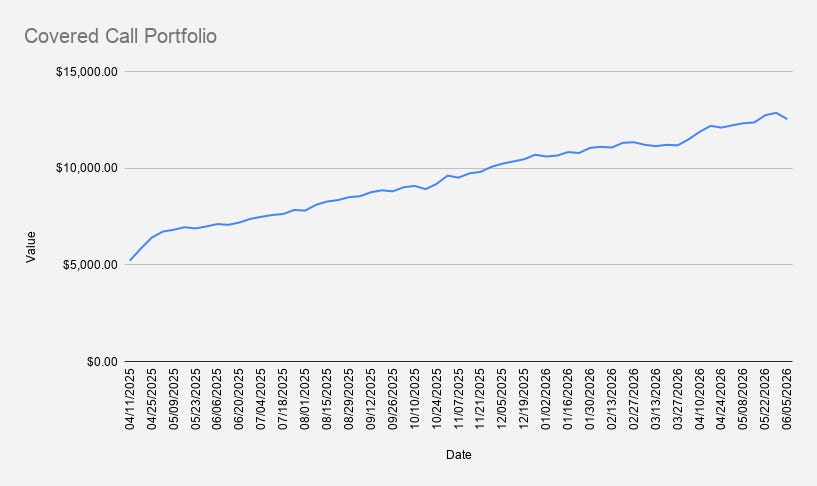
The decline was not entirely driven by stock performance. Currency movement played a role as well. The U.S. dollar strengthened against the euro, with EUR/USD moving toward approximately 1.15. Since part of the portfolio is euro-sensitive, exchange rate fluctuations can influence the reported portfolio value even when the underlying positions remain largely intact.
On a year-to-date basis, the portfolio is still up 21.07%, outperforming both the S&P 500, which gained 9.21%, and NVDA, which gained 19.32% over the same period.
NFLX Credit Spread Got Challenged
The most important event this week was the NFLX position.
My original idea was to run weekly credit spreads on two core names: NVDA and NFLX. The idea made sense in theory. NVDA had been the main engine of weekly premium income, and adding NFLX was supposed to diversify the portfolio and reduce dependence on one stock.
In practice, the NFLX trade was challenged almost immediately.
I first rolled the NFLX bull put credit spread out to a later expiration. However, as NFLX continued moving lower and the share price dipped below $82, I decided to make a larger adjustment.
Instead of continuing to manage the short-term spread, I converted the position into a cash-secured put with an August expiration while lowering the strike price to $76. The adjustment was done for additional premium.
This is a good reminder that even relatively conservative credit spreads can become uncomfortable when the underlying stock moves sharply against the position.
For readers new to this strategy, I explain the basic mechanics here: Bull Put Spread Strategy: A Complete Beginner’s Guide to Selling Credit Spreads for Income.
For now, the dual-stock weekly credit spread idea has been challenged. I am left primarily with NVDA as the weekly credit spread candidate, while NFLX has temporarily moved into the cash-secured put category.
Adding Lufthansa With a Cash-Secured Put
Another new position this week came from Lufthansa.
After booking a trip to Ireland with Lufthansa, I decided to take a closer look at the company and opened a cash-secured put on LHA shares traded in Frankfurt.
The position is:
LHA FRA Sep 18, 2026 7.6 Cash-Secured Put
This is not a weekly options income trade. It is a longer-dated position that fits more naturally into the cash-secured put and European stock part of the portfolio.
I wrote more about the Lufthansa setup here: Selling Cash-Secured Puts on Lufthansa (LHA).
Current Options Positions
NVDA Jun 12, 2026 197.5/185 Bull Put Credit Spread
2x BMY Jun 18, 2026 50/46 Bull Put Credit Spread
DBK FRA Jun 19, 2026 24/20 Bull Put Credit Spread (EUR)
NFLX Aug 21, 2026 76 Cash-Secured Put
LHA FRA Sep 18, 2026 7.6 Cash-Secured Put (EUR)
ARCC Sep 18, 2026 16 Cash-Secured Put
NVDA Jun 17, 2027 $125 Covered Call
Most of the short-term premium still comes from credit spreads, especially NVDA. Longer-dated positions such as NFLX, LHA, and ARCC are now acting more like income-generating cash-secured put positions rather than weekly trades.
Reinvesting Premium Into Shares
Using premium collected this week, I added:
0.1 shares of NVDA
0.1 shares of NFLX
This remains one of the core ideas behind the portfolio: using options premium not only for short-term cash flow, but also as a mechanism to gradually accumulate productive assets over time.
Even small weekly additions can compound meaningfully when repeated consistently.
This is why I look at the portfolio as both an income portfolio and a long-term growth portfolio. The goal is not simply to collect premium. The goal is to use that premium to slowly build ownership.
$157 in Options Premium Income
This week produced $157 in options premium income.
That number was helped by the two longer-term cash-secured puts sold or adjusted this week: NFLX and LHA.
I do not expect this level of weekly premium to continue every week. For the coming weeks, I do not currently see an easy path to consistently generating more than $100 per week without increasing risk.
This fits the broader reality of small-account options trading. A $100 weekly premium target is possible, but it is not automatic. It depends on portfolio size, market conditions, available setups, and risk management.
I discussed this topic in more detail here: Can You Really Earn $100 Per Week Selling Options?.
Margin Debt Drops Below $3,000
One positive milestone this week was the margin balance.
For the first time since starting this portfolio, margin debt dropped below $3,000 and reached approximately -$2,967.
At a sustained $157 weekly premium pace, the debt could theoretically be eliminated in roughly 19 weeks.
However, I do not want to rely on that assumption. Markets rarely stay favorable for long, and this week’s premium was boosted by longer-term adjustments, especially the NFLX roll and the Lufthansa put.
A dividend payment from Deutsche Bank also helped reduce the margin balance.
While it is encouraging to see the margin balance fall below $3,000, I still believe it is becoming increasingly unlikely that the balance will reach zero during 2026. Extending the debt-reduction timeline into 2027 remains acceptable.
The priority is not speed. The priority is survival, consistency, and avoiding unnecessary leverage.
Key Position to Watch Next Week
The main position to monitor next week is:
NVDA 197.5/185 Bull Put Spread
If this position comes under pressure, the plan remains unchanged: roll forward whenever possible, ideally for a net credit, while prioritizing portfolio stability over short-term perfection.
I have written more about this trade management process here: How to Manage a Credit Spread When the Trade Moves Against You.
Key Takeaway
This week was a useful reminder that not every strategy works smoothly every week.
The NFLX weekly credit spread idea was challenged quickly and had to be adjusted into a longer-term cash-secured put. At the same time, the portfolio still generated $157 in premium, reduced margin debt below $3,000, and added more NVDA and NFLX shares.
That is the real purpose of this portfolio: not perfect trades, but a repeatable process.
Credit spreads, cash-secured puts, covered calls, dividends, and gradual share accumulation all work together toward the same goal: building a portfolio that can generate income while continuing to grow over time.
Related Reading
Bull Put Spread Strategy: A Complete Beginner’s Guide to Selling Credit Spreads for Income
How to Manage a Credit Spread When the Trade Moves Against You
Disclaimer: This trade journal reflects personal portfolio activity and is provided for educational and informational purposes only. It should not be considered investment advice or a recommendation to buy or sell any security, option, derivative, or financial instrument. Options trading involves risk and may not be suitable for all investors.
