As of September 25, 2026, our latest portfolio snapshot stood at $13,733, representing a small 0.2% increase compared with the previous week.
The $14,000 milestone remains within reach, but we have now been struggling to break through that level for several weeks.
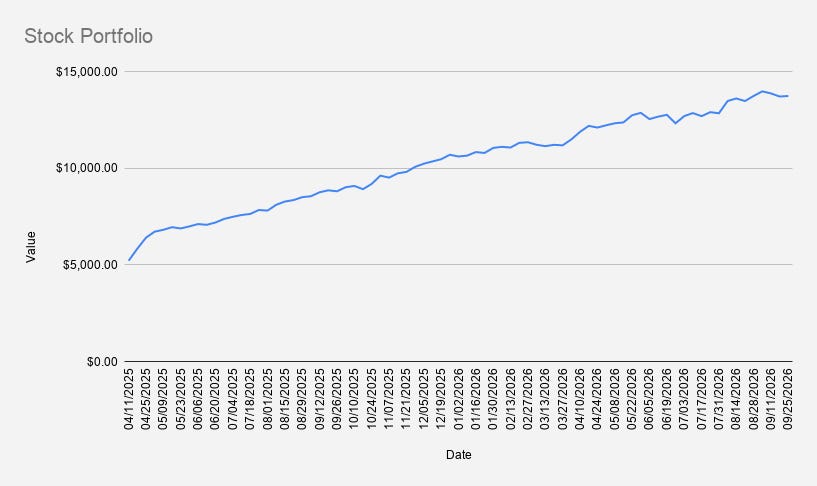
The portfolio is now up 34.41% year to date. For comparison, the S&P 500 is up roughly 13% in 2026, while NVDA is up around 20%.
Beating both feels satisfying, but it also needs to be viewed in context. We have generated these returns while selling options during what remains a broadly positive year for U.S. equities. The more meaningful test will be whether the strategy can continue producing acceptable returns when markets become significantly less supportive.
The important point is not simply that the portfolio is ahead of the benchmarks. Our returns come with a very different risk profile. We actively sell option premium, use margin, roll positions when necessary and occasionally accept assignment. These tools can improve returns and provide flexibility, but they also introduce leverage, assignment risk and the possibility of locking capital into positions for much longer than originally planned.
Market Context
This week provided a useful reminder of those risks. The broader U.S. market remained close to record territory, but conditions underneath the indexes were less comfortable. Treasury yields remained elevated, oil continued trading around unusually high levels, and expectations for tighter Federal Reserve policy remained an important pressure point.
Financial stocks were particularly weak during part of the week as investors reacted to narrowing yield spreads. Bank of America fell sharply on September 22 and finished September 24 around $56, materially below where it traded earlier in the month.
Technology remained relatively stronger. NVDA finished September 24 around $224.58, slightly higher than the previous Friday despite some volatility during the week. That strength helped the portfolio, but it also means our exposure to NVDA remains significant.
Netflix continues to be one of the weaker names in the portfolio. The stock finished September 24 around $71.70 after falling sharply earlier in September. A recent analyst downgrade also highlighted concerns about engagement and content performance. With Netflix earnings expected in October, volatility around that position could remain elevated.
This Week’s Adjustments
This week was more challenging for our BAC position. With BAC falling below our previous $57.50 strike, I decided to take early action and roll the put out to the March 2027 expiry while lowering the strike to $55.
The adjustment improves the strike and generated additional premium, but the trade-off is significant: capital is now committed for another six months. Rolling does not eliminate the underlying economic risk. It gives the position more time to recover and improves the entry level, but it also extends the duration of the trade.
Hopefully BAC does not develop into another NFLX situation, where we have already rolled the short put toward the end of 2027.
We also made a significant adjustment to our deep ITM NVDA covered call. I rolled the position up and forward from June 2027 to January 2028, improving the strike from $125 to $130 while collecting approximately another $160 in premium.
Taken together, the adjustment adds roughly $662 in additional value if we ultimately allow the NVDA shares to be called away at expiry.
There is, however, another side to this trade. With NVDA trading above $220, the $130 covered call remains extremely deep in the money. The position therefore provides relatively little participation in further NVDA upside. Extending the option into 2028 improves the economics of the roll, but it also reduces flexibility and keeps the shares tied to the position for considerably longer.
Additionally, this week’s NVDA credit spread expired worthless. I opened another weekly spread, generating some additional premium.
Current Options Positions
NVDA OCT 2, 2026 212.5/202.5 Bull Put Credit Spread
BMY OCT 16, 2026 57.5/52.5 Bull Put Credit Spread
NFLX NOV 20, 2026 85/105 Bear Call Spread
LHA FRA DEC 18, 2026 7 Cash-Secured Put
BAC MAR 19, 2027 55 Cash-Secured Put
NFLX DEC 17, 2027 64 Cash-Secured Put
NVDA JAN 21, 2028 $130 Covered Call
Where Are the Biggest Risks?
Looking at the portfolio position by position, I do not think any single trade is currently catastrophic. The bigger concern is how several exposures could interact during a sharp market decline.
The most immediate position to watch is probably BAC. With the stock around $56 and our new strike at $55, there is currently only a small cushion. The March 2027 expiry gives the position plenty of time, but another meaningful decline in financial stocks could quickly put the option back in the money.
The weekly NVDA 212.5/202.5 credit spread is much shorter dated.The short strike is roughly 5% below the stock. The risk is clearly defined: if NVDA suffered a sudden drop through both strikes, the maximum loss would be approximately $1,000 per spread minus the premium originally received.
This is exactly why I prefer using a spread instead of selling a naked weekly NVDA put. A sharp one-week move can still hurt, but the long $202.50 put puts a hard ceiling on the loss.
The BMY 57.5/52.5 spread has similar characteristics. BMY was around $60.75 leaving roughly a 5% cushion above the short strike. Its maximum theoretical loss is $500 per spread minus the premium received.
The NFLX positions are more complicated. At approximately $71.70, the November $85/$105 bear call spread remains comfortably out of the money. At the same time, we are short the December 2027 $64 put. That creates an unusual combination: over the short term we benefit from NFLX remaining below $85, while over the longer term we ultimately need the stock to remain reasonably healthy.
The $64 NFLX put is currently about 11% below the share price, but its very long expiry means there is plenty of time for the underlying story to change. NFLX therefore remains one of the positions I am least interested in adding to.
Lufthansa is currently trading around €7.57 against our €7 strike. That provides a reasonable cushion, but airlines remain highly sensitive to fuel prices, economic conditions and geopolitical disruptions. With oil elevated, that remains a risk worth monitoring.
The Real Tail Risk
The biggest portfolio risk is not that one credit spread expires at maximum loss. Those losses are defined and manageable.
The real tail risk would be a broader equity correction that hits several positions simultaneously.
Imagine NVDA falling sharply, BAC moving well below $55, NFLX breaking below $64 and volatility rising across the entire market at the same time. The long-dated short puts would become more expensive to close, margin requirements could increase, and the value of the equity portfolio itself would decline.
That combination matters because we are currently carrying a margin balance. Rolling individual positions works well when problems arrive one at a time. It becomes substantially harder when several positions require attention simultaneously.
This is the main reason I do not want to chase additional option premium at the moment.
Premium Income
Total options premium collected this week reached $233.71, making it our second-strongest week so far.
I would obviously like to see more weeks like this, but it is important to recognize where much of that premium came from. A significant portion was generated by rolling both the BAC put and the NVDA covered call further out in time.
In other words, the $233 should not be treated as a sustainable weekly income run rate. Part of that income was effectively received in exchange for extending the duration of existing obligations.
For the next few weeks, I do not expect options premium to be anywhere near this level. A more realistic range is probably around $40–$70 per week, with the upper end already requiring somewhat more risk.
At this stage, I am not planning to open additional options positions beyond the weekly NVDA credit spreads. The main focus will be managing the positions already in the portfolio and avoiding unnecessary risk simply to generate more premium.
Reinvesting Premium
As usual, part of the income was recycled back into the portfolio rather than simply sitting as cash. This week we added 0.1 BAC share, 0.1 NFLX share, 1 NU share and 0.1 NVDA share.
These purchases are deliberately small. The idea is not to predict the perfect entry price, but to gradually turn options income into ownership of businesses we are comfortable holding over a longer period.
Margin Update
The margin balance decreased slightly to −$2,508.
At this week’s premium generation of approximately $233, it would theoretically take around 11 weeks to eliminate the remaining margin balance if every dollar of options income were directed toward reducing it and weekly premium remained unchanged.
Realistically, however, I do not expect to generate anything close to $233 per week consistently. For the coming weeks and months, I consider approximately $50–$70 in weekly options income a much more realistic range.
At $50 per week, eliminating $2,508 of margin through options income alone would take roughly a year. At $70 per week, it would still take around nine months, assuming no additional margin use and ignoring interest costs, portfolio withdrawals or new investments.
That means completely eliminating the margin balance sometime during 2027 would already represent a good outcome, particularly if it can be achieved without taking unnecessary additional risk.
The broader goal remains unchanged: keep margin manageable while allowing the portfolio to compound.
What I Will Watch Next Week
The most immediate focus will be NVDA. Our 212.5/202.5 credit spread expires on October 2, so the distance between NVDA and the $212.50 short strike will matter more than generating another few dollars of premium.
I will also be watching BAC closely. After this week’s sharp move in financial stocks, I want to see whether BAC can stabilize above the mid-$50s. The March expiry gives us time, but I would prefer not to see the position immediately move back below the new $55 strike.
Bond yields and oil are probably the two most important macro variables for the portfolio next week. Persistently high Treasury yields could pressure equities and financial conditions, while another jump in oil would be particularly relevant for inflation expectations and our Lufthansa exposure.
NFLX also remains on the watchlist. I am not planning another adjustment simply because the stock moves a few dollars, but with earnings approaching in October and the stock already significantly weaker this year, I want to avoid adding further exposure before we have more information.
Bottom Line
On the surface, this was another positive week: the portfolio gained slightly, year-to-date performance remains strong and we collected $233.71 in option premium.
Underneath those numbers, however, the portfolio has become more complicated.
Both BAC and NVDA required us to extend positions further into the future. NFLX already has capital tied up until late 2027. The margin balance remains above $2,500. None of these issues is unmanageable individually, but together they argue for patience rather than trying to maximize weekly premium.
I therefore see the portfolio as being in a reasonably stable position, but certainly not a low-risk one. The defined-risk spreads are doing exactly what they are supposed to do, while the larger structural risks come from the long-dated short puts, the deep ITM NVDA covered call, concentration in a handful of individual stocks and the use of margin.
For now, the priority is simple: protect the strong year-to-date result, gradually reduce margin, keep the weekly NVDA spreads small and defined, and avoid turning temporary market weakness into another multi-year roll.
If the portfolio can eventually move through $14,000 while simultaneously reducing leverage rather than increasing it, that would be a much healthier milestone than reaching $14,000 simply by taking more risk.
